CALL US NOW
 TEXT US NOW
Why Seattle back and neck injury victims call Elsner Law Firm
Medical evidence guidance for delayed pain, imaging, specialist care, physical therapy, injections, surgery recommendations, and ongoing limitations.
Insurance pushback support when adjusters minimize soft-tissue injuries, blame preexisting conditions, or pressure you into a low settlement.
Crash and liability review for police reports, vehicle damage, witness statements, and the force that caused your back or neck injury.
Washington personal injury focus for people hurt in Seattle-area crashes with spine, neck, and back injuries.
Free case review by phone at 206-447-1425.
Hurt your back or neck in a Seattle crash, a fall, or on the job? You may have a claim for medical bills, lost wages, and pain. Talk to a Seattle back and neck injury lawyer before the insurer writes off your injury as a minor strain.
Back and neck injuries are the most common serious injuries in car accidents, workplace accidents, and falls across King County. The pain often shows up days later. Imaging can miss soft tissue injury. Insurers use both facts to cut your payout.
Elsner Law Firm represents injured people in Seattle, Tacoma, Bellevue, Everett, and across Western Washington. We handle car crashes, truck accidents, rideshare collisions, construction injuries, slip and falls, and maritime accidents. Our work covers whiplash, herniated discs, spinal stenosis, cervical myelopathy, and spinal cord injuries.
Free case review. No fee unless we win. Call 206-447-1425 today.
Why injured workers and crash victims call us:
- Medical evidence guidance for delayed injury, MRI findings, specialist care, and surgery recommendations
- Insurance pushback support when adjusters minimize soft tissue injury or blame a preexisting condition
- Crash and liability review for police reports, vehicle damage, and witness statements
- L&I and workers’ compensation help for back and neck injuries at the workplace
- Third-party liability review when someone other than your employer caused your injury at work
Types of Back and Neck Injuries We Handle
Back and neck injuries range from soft tissue strains to permanent spinal cord damage. Each diagnosis has its own treatment path, settlement value, and proof requirements. Below are the conditions we handle most often as a Seattle back and neck injury attorney.
Whiplash and Neck Sprain
Whiplash is a soft tissue injury caused when the head snaps forward and back. It is the most common rear-end collision injury. Symptoms include neck pain, stiffness, muscle spasm, and headache. Pain often starts 24 to 72 hours after the crash.
Herniated Disc
A herniated disc happens when the soft center of a spinal disc pushes through a tear in the outer ring. The displaced disc material presses on a nerve root and causes radiating pain, numbness, or weakness. Crashes and lifting injuries are the leading causes.
Bulging Disc
A bulging disc is a disc that has lost shape but has not torn. It can still press on the spinal cord or nerve. Bulging discs are often a precursor to herniation.
Pinched Nerve and Radiculopathy
Radiculopathy is pain, numbness, or weakness that travels down an arm or leg because a nerve root is compressed. Cervical radiculopathy affects the arms. Lumbar radiculopathy (sciatica) affects the legs.
Spinal Stenosis
Spinal stenosis is a narrowing of the spinal canal. Trauma can speed up or worsen stenosis from prior degeneration. Symptoms include leg pain when walking, numbness, and balance problems.
Cervical Myelopathy
Cervical myelopathy is spinal cord compression in the neck. It can cause hand clumsiness, balance loss, and bladder problems. It often requires surgery and is a high-value injury claim.
Lumbar Strain and Sprain
A lumbar strain is a torn muscle or tendon in the lower back. A lumbar sprain is a torn ligament. Both produce sharp lower back pain and muscle spasm that limit lifting and bending.
Spondylolysis and Spondylolisthesis
Spondylolysis is a stress fracture in a spinal vertebra. Spondylolisthesis happens when one vertebra slips forward over the one below it. Trauma and repetitive strain can trigger both.
Neck Fracture and Cervical Vertebrae Injury
A neck fracture is a break in one of the seven cervical vertebrae. It is a medical emergency. Even stable fractures can lead to chronic pain and limited motion. If your accident caused a broken bone or fracture, an attorney can help document the full extent of your injury.
Spinal Cord Injury, Paralysis, Paraplegia, Quadriplegia
A spinal cord injury can cause partial or complete paralysis. Paraplegia is paralysis of the legs. Quadriplegia is paralysis of the arms and legs. These are catastrophic injuries with lifetime medical costs that often exceed $1 million.
Delayed Injury and Chronic Pain
A delayed injury is one where pain appears days or weeks after the accident. Chronic pain is pain that lasts longer than six months. Both are common in back and neck cases and both are routinely undervalued by insurance adjusters.

Where These Injuries Happen in Seattle
Back and neck injuries in Seattle happen in cars, at work, in maritime settings, and on unsafe property. The legal claim path depends on where and how you were hurt. The list below shows the settings we see most often as a Seattle back and neck injury lawyer.
Car, Truck, and Rideshare Crashes on I-5, I-90, and SR 99
Most back and neck injury claims in King County start with a motor vehicle accident. Rear-end collisions cause whiplash. Truck crashes cause herniated discs and fractures from high-impact force. Rideshare crashes involving Uber and Lyft drivers add a $1 million liability policy that many injured riders do not know about. The Washington State Department of Transportation reports more than 100,000 motor vehicle crashes statewide each year.
Workplace and Construction Site Accidents
Construction workers, warehouse staff, and healthcare workers file the largest share of L&I back and neck claims in Washington. Falls from scaffolding, struck-by-object events, and repetitive lifting are common causes. Amazon warehouse workers in Kent, Sumner, and DuPont file thousands of L&I claims each year for back and neck strain.
Maritime, Dock, and Pier Injuries on the Puget Sound
Maritime workers along Elliott Bay, Harbor Island, and the Port of Seattle face high spinal injury risk. Falls on slippery decks, sudden ship movement, and heavy cargo handling cause herniated discs and lumbar fractures. Maritime back injuries fall under federal law (the Jones Act or the Longshore and Harbor Workers’ Compensation Act), not state L&I. If you were injured on a vessel, talk to a boat accident lawyer in Seattle about your federal claim options.
Slip and Fall on Unsafe Property
Property owners must keep walkways, stairs, and parking lots reasonably safe. Wet floors, ice, broken stairs, and bad lighting cause falls that injure the back and neck. Slip and fall claims fall under premises liability law.
Industrial Accidents and Heavy Equipment Injuries
Industrial accidents involving forklifts, presses, and conveyor systems often cause crush injuries to the spine. These cases often involve a workers’ compensation claim and a third-party product liability claim at the same time.
Common Accidents Causing Back and Neck Injuries in Seattle
Most back and neck injury claims in Seattle come from one of six accident types. Each one creates a different liability and damage profile.
- Rear-end collisions cause whiplash and cervical strain. They are the most common cause of neck injury claims nationwide.
- Head-on crashes cause high-impact spinal trauma including fractures and disc herniation.
- T-bone and side-impact crashes twist the spine and frequently cause cervical disc injury.
- Rollover accidents create multi-point spinal trauma and a high rate of catastrophic outcomes.
- Commercial truck crashes cause severe spine injuries due to size and weight difference. Federal regulations under 49 CFR govern truck driver hours and equipment.
- Motorcycle and bicycle crashes throw riders to the ground and frequently injure the cervical spine.
- Pedestrian accidents in downtown Seattle, Capitol Hill, and Ballard cause spine injuries from vehicle impact and from the secondary fall.
- Slip and fall incidents on wet floors, icy walkways, and broken stairs cause lumbar strain and disc injury.
- Workplace and construction site accidents cause the largest share of back injury claims filed with Washington L&I each year.
- Maritime accidents on commercial vessels and at dock cause spine injuries that fall under federal Jones Act and Longshore Act protection.
Why Back and Neck Pain Often Shows Up Days After the Accident
Pain from a back or neck injury can start hours or days after the crash. The body releases adrenaline at the moment of impact, which masks pain. Soft tissue swelling builds slowly. Muscle spasm tightens over the next 24 to 72 hours. This delayed pain pattern is normal, well-documented in medical research, and not a sign that you were faking.
Delayed injury creates two problems for your claim. First, the gap between the crash date and the first doctor visit gives the adjuster room to argue your pain was not from the accident. Second, soft tissue injury does not show up on an X-ray. Whiplash is diagnosed by symptoms, range-of-motion testing, and clinical exam, not by imaging alone.
Insurance companies use both facts to undervalue back and neck claims. They argue that if you waited three days to see a doctor, the injury must be minor. They argue that if the MRI is normal, you cannot really be in pain. Both arguments are wrong. Learn more about why seeking medical care immediately after an accident matters for your health and your claim.
What to do if pain appears late:
- See a doctor within 72 hours, even if pain is mild
- Tell the doctor every symptom, including headache, brain fog, insomnia, and tingling
- Keep every receipt, imaging report, and prescription
- Avoid signing any insurance release until you talk to a back and neck injury attorney
Medical Diagnosis and Testing for Back and Neck Injuries
Proper medical documentation drives both your recovery and your claim value. The right tests prove the existence of the injury, the location of the damage, and the need for ongoing care.
Standard diagnostic tests for back and neck injury:
- X-rays detect fractures and alignment problems ($200 to $400)
- MRI scans are the gold standard for soft tissue, disc, and nerve imaging ($1,000 to $3,000)
- CT scans give three-dimensional bone imaging that catches missed fractures ($500 to $1,500)
- Electromyography (EMG) measures nerve function and muscle activity
- Nerve conduction studies measure how fast nerve signals travel
- Physical examination documents range of motion, strength, and reflex
- Bone scans identify stress fractures and tumors
- Myelogram uses contrast dye to visualize nerve compression
- Ultrasound imaging shows soft tissue inflammation without radiation
The American College of Radiology confirms that MRI is the most reliable single test for evaluating disc injury and nerve compression in the spine.
Treatment Options and Recovery for Back and Neck Injuries
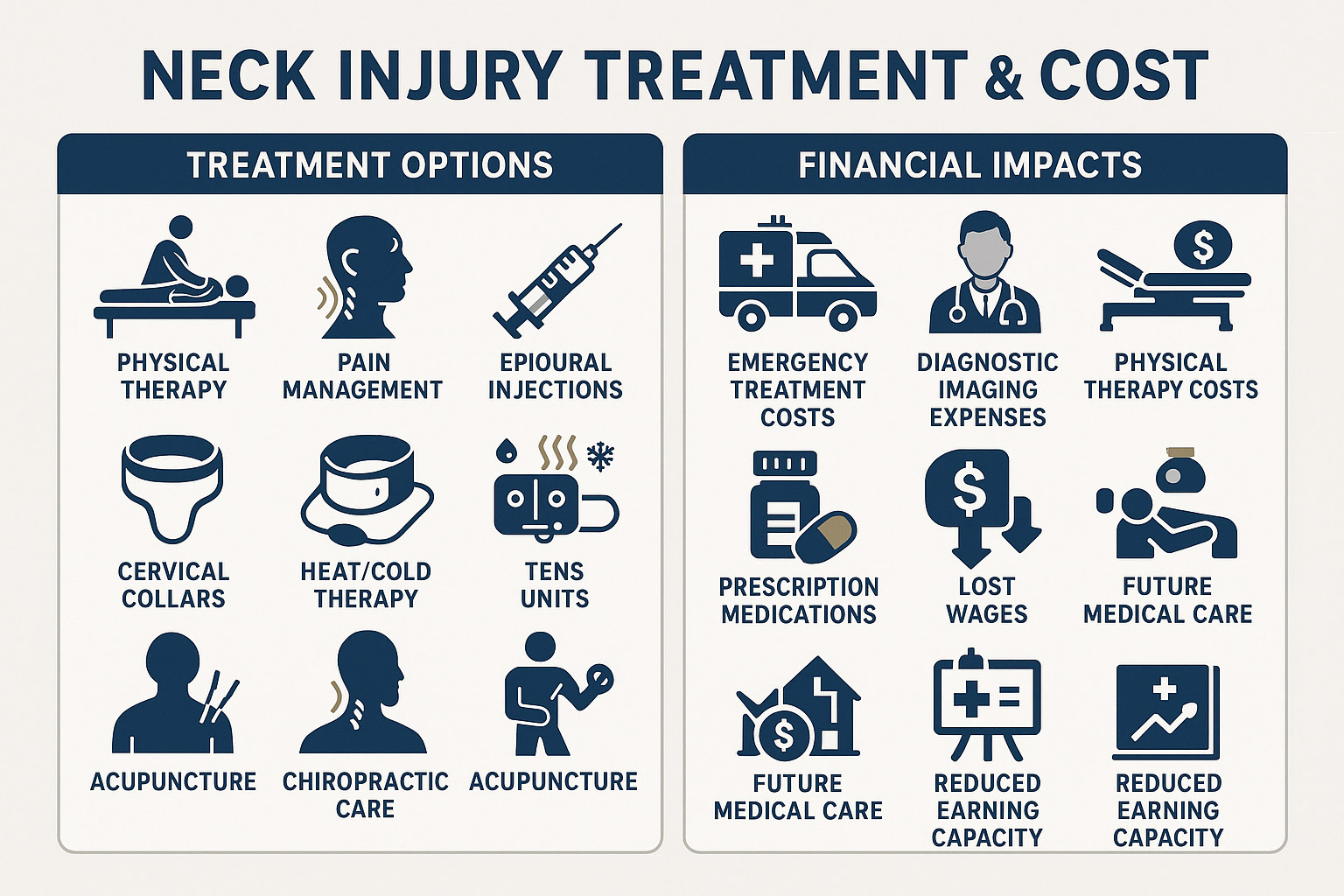
Most back and neck injuries start with conservative care. Surgery is the last step when other treatment fails. Documenting every step protects both your health and your claim.
Conservative treatment options:
- Physical therapy at 2 to 3 sessions per week ($150 per session)
- Pain management including anti-inflammatory drugs and muscle relaxants
- Manual therapy including joint mobilization, traction, and massage
- Epidural steroid injections for nerve compression
- Cervical collar for short-term support
- Heat and cold therapy
- TENS unit for nerve stimulation
- Chiropractic care
- Acupuncture
- Home exercise program
Surgical treatment options when conservative care fails:
- Discectomy to remove herniated disc material
- Anterior cervical discectomy and fusion (ACDF) for cervical disc injury
- Lumbar fusion to stabilize the lower spine
- Artificial disc replacement to preserve motion
- Laminectomy to relieve spinal stenosis
Surgical recovery typically requires 6 to 12 months and creates permanent restrictions that affect work and lifestyle.
Workers’ Compensation and L&I Claims for Back and Neck Injuries
If your back or neck injury happened at work in Washington, you file a claim with the Department of Labor & Industries (L&I), not against your employer. Washington is a monopolistic workers’ comp state under RCW Title 51. L&I covers medical treatment, time loss compensation, permanent partial disability, total disability pension, and vocational retraining.
You have one year from the date of injury to file an L&I claim for a sudden workplace accident. For occupational disease (such as repetitive lifting that wears down a disc over years), the clock starts when you knew or should have known the condition was work-related.
Time Loss Compensation
Time loss compensation pays a portion of your wages while you cannot work because of a back or neck injury. The benefit is calculated at 60 to 75 percent of your wages, depending on marital status and number of dependents. Payments continue until your doctor releases you to work or until your condition is fixed and stable.
Permanent Partial Disability (PPD)
Permanent partial disability is paid when your back or neck injury leaves you with a permanent impairment but you can still work in some capacity. PPD is paid as a lump sum or in installments based on the body-part rating in the L&I schedule. A cervical fusion, lumbar fusion, or chronic radiculopathy can each qualify for a PPD award.
Total Disability Pension
A total disability pension pays monthly for the rest of your life when a back or neck injury prevents you from doing any reasonably available work. L&I considers your age, education, work history, and medical restrictions. Pension claims are the most contested type of L&I claim and most denials can be appealed.
Loss of Earning Power Benefits
Loss of earning power benefits pay the difference between your pre-injury wages and what you can earn now while you recover. They apply when you go back to work part-time or to a lower-paying job because of medical restrictions. Learn how to prove loss of wages in a personal injury case to protect your claim value.
Vocational Retraining
Vocational retraining is up to two years of L&I-funded education or job training when your back or neck injury keeps you from returning to the job of injury. Approved retraining can include certificate programs, community college, and apprenticeships.
When You Can File Both an L&I Claim and a Personal Injury Lawsuit
You can file both an L&I claim and a personal injury lawsuit when someone other than your employer caused your work injury. The third party can be an at-fault driver, a subcontractor, a property owner, or a product manufacturer. The personal injury recovery is in addition to L&I benefits, but L&I has a subrogation lien on part of any third-party settlement. A Seattle back and neck injury attorney coordinates both claims to maximize total recovery.

Spinal Cord Injuries: When a Back or Neck Injury Becomes Catastrophic
A spinal cord injury is the most severe type of back or neck injury. It happens when trauma cuts off the nerve signal between the brain and the body. The level of paralysis depends on where on the spinal cord the injury occurs.
- C1 to C4 injuries cause quadriplegia and often require a ventilator
- C5 to C8 injuries cause partial arm and full leg paralysis
- T1 to T12 injuries cause paraplegia with use of the arms preserved
- L1 to L5 injuries cause partial leg paralysis and loss of bladder or bowel control
The National Spinal Cord Injury Statistical Center reports that lifetime costs for a high cervical spinal cord injury exceed $5.4 million. Costs for paraplegia exceed $2.5 million. These figures cover medical care only and do not include lost wages or non-economic damages.
Spinal cord injury claims require a life care plan, vocational expert testimony, and an economist’s report on future losses. As a Seattle spinal cord injury attorney, we work with rehabilitation physicians and life-care planners to document every projected cost so the settlement covers a lifetime of need.
Damages You Can Recover for a Back or Neck Injury in Washington
Washington law lets you recover economic and non-economic damages for a back or neck injury caused by someone else’s negligence. The Sofie v. Fibreboard ruling in 1989 struck down caps on non-economic damages in personal injury cases, so there is no statutory limit on pain and suffering for spine injuries in this state.
Economic Damages
Economic damages are verifiable money losses. They include:
- Emergency room treatment ($3,000 to $8,000 typical)
- Ambulance transport ($800 to $1,200)
- Diagnostic imaging including MRI ($1,000 to $3,000 per scan)
- Specialist visits with orthopedic surgeons, neurologists, and pain management doctors
- Physical therapy ($150 per session, often 24 to 48 sessions)
- Prescription medication
- Lumbar or cervical fusion surgery ($60,000 to $150,000)
- Lost wages
- Loss of future earning capacity
- Vocational retraining costs
- Home and vehicle modifications for paralysis cases
Non-Economic Damages
Non-economic damages cover losses that do not have a dollar receipt. They include:
- Pain and suffering
- Emotional distress
- Loss of enjoyment of life
- Loss of consortium for a spouse
- Permanent impairment
- Disfigurement
Punitive Damages
Washington does not allow punitive damages in most personal injury cases. The exception is when a federal statute applies (such as maritime law) or when the case is filed under another state’s law that allows them.
Washington Personal Injury Laws That Affect Your Back and Neck Claim
Washington law gives you three years to file a personal injury lawsuit under RCW 4.16.080(2). The clock starts on the date of the accident. Acting earlier protects evidence, witness memory, and medical documentation. Read more about the dangers of delaying legal action in your personal injury case.
Pure Comparative Negligence (RCW 4.22.005)
Washington follows a pure comparative negligence rule. You can recover damages even if you are 99 percent at fault. Your award is reduced by your share of fault. This rule helps Seattle drivers, cyclists, and pedestrians in close-call crash scenarios.
No Cap on Non-Economic Damages
There is no statutory cap on pain and suffering for personal injury in Washington. The state Supreme Court struck down the legislative cap in Sofie v. Fibreboard Corp. (1989).
Claims Against Government Entities (RCW 4.96.020)
If your back or neck injury was caused by a Seattle Department of Transportation worker, a King County Metro bus accident, a Sound Transit train, or another government vehicle, you must file a tort claim form with the agency at least 60 days before filing a lawsuit. The three-year statute of limitations is tolled (paused) for those 60 days.
Personal Injury Protection (PIP)
Washington insurers must offer PIP coverage with every auto policy. PIP pays up to $10,000 in medical bills regardless of fault. It can be increased to $35,000 with higher limits. PIP pays for chiropractic, physical therapy, and prescriptions for your back or neck injury without waiting on the at-fault driver’s insurance. Learn more about how PIP works in Washington.
Subrogation and the Made-Whole Doctrine
If your health insurance or PIP pays for back or neck treatment, the insurer may have a subrogation right to be repaid from your settlement. The made-whole doctrine in Washington often reduces or eliminates that lien when the settlement does not fully cover your losses.
Why Choose Elsner Law Firm for Your Back and Neck Injury Case
Decades of combined experience representing Seattle injury victims gives our team a working knowledge of local courts, medical providers, and insurance company tactics. We treat every case like the only case.
What sets Elsner Law Firm apart:
- Decades of combined experience in back and neck injury claims
- Free consultations with no upfront cost
- Contingency fee, so you pay only if we win
- Virtual and in-person service options
- Strong relationships with Seattle medical specialists for testimony
- Multilingual staff serving King County’s diverse population
- Direct attorney access throughout your case
- Proven results in motor vehicle, workplace, construction, and maritime spine claims
The Claims Process and Legal Strategy
Our process moves your case forward while you focus on healing. Each step is built to maximize recovery and minimize stress.
- Free case evaluation of your accident, injury, and damages
- Medical record collection from every provider
- Accident investigation including scene analysis and witness interviews
- Demand and negotiation with the at-fault insurer
- L&I claim coordination for work-related injuries
- Litigation filing when the insurer refuses fair compensation
- Trial preparation and advocacy in King County Superior Court
- Settlement distribution with full accounting of lien resolution
Frequently Asked Questions About Back and Neck Injury Claims in Seattle
Why does my neck hurt days after the crash?
Soft tissue swelling and muscle spasm build slowly, and adrenaline masks pain at impact. Whiplash pain often starts 24 to 72 hours after the accident. Delayed pain is medically normal and does not weaken your claim if you document it.
Can I file an L&I claim and a personal injury lawsuit for the same back injury?
Yes, when a third party (not your employer) caused the workplace injury. The third party can be an at-fault driver, a subcontractor, or a product maker. L&I covers medical and wages. The personal injury claim covers pain, suffering, and full lost earnings.
How much is a back or neck injury settlement worth in Washington?
Settlement value depends on injury severity, treatment costs, lost wages, and fault. Minor whiplash cases settle for $10,000 to $25,000. Herniated disc cases with injections range from $50,000 to $150,000. Fusion surgery cases often settle for $250,000 to $1 million. Catastrophic injury settlement and spinal cord injury cases can exceed $5 million. See our guide on Washington car accident settlement amounts for more detail on how adjusters calculate value.
What is the difference between a herniated disc and a bulging disc?
A bulging disc has lost shape but is intact. A herniated disc has torn, and inner disc material leaks out and presses on a nerve. Herniated discs typically cause more severe and radiating pain.
Will I need spinal fusion surgery?
Most back and neck injuries do not require surgery. Conservative treatment includes physical therapy, injections, and medication. Fusion or disc replacement is considered when severe pain and nerve damage do not respond to six months of conservative care.
Can I get fired for filing an L&I claim in Washington?
No. RCW 51.48.025 makes it illegal for an employer to fire or discriminate against a worker for filing an L&I claim. An employer who retaliates can owe damages and reinstatement.
What if a King County Metro bus or a Seattle city vehicle caused my injury?
You must file a tort claim form with the government agency at least 60 days before filing suit, under RCW 4.96.020. The three-year personal injury deadline is paused during that 60-day notice period.
Does PIP cover chiropractor and physical therapy?
Yes. Washington PIP pays up to $10,000 (or your policy limit) for chiropractic care, physical therapy, prescriptions, and medical bills from a back or neck injury, no matter who caused the crash.
How long do I have to file a back or neck injury claim in Washington?
Three years from the date of accident for personal injury (RCW 4.16.080(2)). One year for an L&I claim from the date of a sudden injury. Government claims require a 60-day pre-suit notice.
Why do insurance adjusters say my soft tissue injury is minor?
Soft tissue damage does not show up on an X-ray and often does not show on MRI. Adjusters use that imaging gap to argue the injury cannot be serious. A back and neck injury attorney counters with clinical exam findings, treatment records, and pain documentation. If your insurance claim has been denied, do not accept the decision without legal review.
What should I do right after a back or neck injury accident in Seattle?
See a doctor within 72 hours. Photograph the scene. Get the police report number. Do not give a recorded statement to the at-fault insurer. Call a Seattle back and neck injury lawyer for a free case review. For a more detailed walkthrough, see our guide on what to do in the first 24 hours after a collision.
How much does it cost to hire Elsner Law Firm?
Nothing upfront. We work on a contingency fee. You pay only if we recover money for you. The free consultation costs nothing and creates no obligation.
Local Seattle Resources for Back and Neck Injury Recovery
Seattle-area medical centers and rehabilitation providers support back and neck injury recovery. We coordinate with these providers to document treatment and build the medical record needed for your claim.
Major Medical Centers with Spine Programs
- Harborview Medical Center, Level 1 trauma center with neurosurgery
- University of Washington Medical Center spine program
- Swedish Medical Center spine and neuroscience institute
- Virginia Mason Medical Center spine and orthopedic services
- Seattle Children’s Hospital pediatric spine care
Specialized Spine and Pain Centers
- Seattle Spine Team
- Pacific Northwest Spine Center
- Puget Sound Orthopaedics
- Seattle Pain Relief
- Northwest Spine & Sports Physicians
Physical Therapy and Rehabilitation
- BenchMark Physical Therapy
- Therapydia Seattle
- Capitol Hill Physical Therapy
- Rainier Valley Physical Therapy
- Seattle Sports Physical Therapy
Government and Support Resources
- Washington State Department of Labor & Industries for workers’ compensation claims
- Washington State Department of Transportation for crash data and road records
- King County Superior Court for civil filings
- Puget Sound Chronic Pain Support Group
Talk to a Seattle Back and Neck Injury Lawyer Today
Insurance adjusters move fast to minimize back and neck injury claims. Evidence fades. Witnesses forget. The longer you wait, the harder your case gets.
Elsner Law Firm has decades of combined experience helping injured people in Seattle, Tacoma, and across Western Washington recover full compensation for spine injuries. We handle car crashes, truck wrecks, rideshare collisions, workplace accidents, construction site injuries, and maritime cases.
Get your free case review today. No fee unless we win. Call 206-447-1425 or send us a message.
Areas We Serve in Washington State