CALL US NOW
 TEXT US NOW
Why Seattle T-bone crash victims call Elsner Law Firm
Intersection evidence review for traffic signals, stop signs, camera footage, witness statements, and police reports.
Fault-dispute support when insurers argue over right of way, speed, distraction, or who caused the side-impact crash.
Serious-injury claim guidance for emergency care, follow-up treatment, lost wages, pain and suffering, and long-term recovery needs.
Washington personal injury focus for drivers and passengers hurt in Seattle-area side-impact collisions.
Free case review by phone at 206-447-1425.
Hit from the side at a Seattle intersection? A side-impact collision can change your life in one second, and the other driver’s insurer is already building a case against you.
At Elsner Law Firm, our Seattle T-bone accident lawyers help drivers and passengers hurt in broadside crashes across King County. We have spent 18+ years fighting for injury victims and the money they are owed. A T-bone accident attorney can deal with the insurance company, protect your rights, and push for full payment while you heal. You pay nothing unless we win. Call (206) 447-1425 for a free case review today.
What Makes T-Bone Accidents So Dangerous in Seattle?
T-bone accidents are deadly because victims have little protection from a side impact. Seattle’s busy intersections see frequent side-impact collisions that cause traumatic brain injuries, spinal cord damage, and broken bones.
A side-impact collision, also called a broadside crash, happens when one vehicle strikes another from the side. The crash forms a ‘T’ shape at impact. Unlike a front or rear crash, your car’s side offers little protection. You have only a door and a window between you and the other vehicle. National crash data from the IIHS shows side-impact crashes cause about a quarter of vehicle-occupant deaths.
Seattle’s driving conditions make these crashes more common:
- Heavy downtown traffic during rush hours
- Complex intersections in Capitol Hill and Belltown
- Rainy roads that cut visibility and traction
- Distracted drivers on busy streets like Pike Street and Pine Street
Common T-Bone Accident Injuries
These serious injuries often follow a side-impact crash: traumatic brain injury, spinal cord injury and paralysis, broken bones, internal organ damage, chest injury, hip injury, concussion, facial trauma, nerve damage, and whiplash or neck and back pain. Intersection crashes account for over 40% of all traffic collisions in King County.
Who Is at Fault in a Seattle T-Bone Accident?
Fault in a T-bone accident depends on right-of-way violations, traffic signal compliance, and driver behavior. Fault follows who had the right of way, not who hit whom.
Determining fault takes a careful look at the evidence. Many people assume the driver who hit the side is always at fault. That is not always true.
Seven Key Factors We Investigate
- Traffic Laws and Right of Way. RCW 46.61.180 covers two cars reaching an intersection together. RCW 46.61.190 covers stop and yield signs. RCW 46.61.185 covers left turns. Running a red light or a stop sign usually puts that driver at fault.
- Police Reports. Officer notes and citations are strong evidence. We review every document from the scene.
- Eyewitness Statements. Independent witnesses give objective accounts that often settle disputed facts.
- Vehicle Damage. Impact spot and severity help reconstruct the crash. Our accident reconstruction experts read the damage patterns.
- Traffic and Dashcam Footage. Video from traffic cameras or nearby businesses shows what happened before impact.
- Accident Reconstruction. In hard cases, specialists rebuild the crash from skid marks, debris, and impact angles.
- Vehicle Black Box Data. Most cars store speed, braking, and throttle data in an event data recorder. We move fast to pull this before it is lost.
Washington’s Comparative Negligence Law
You can still get money after a T-bone accident even if you were partly at fault. Washington uses pure comparative fault negligence under RCW 4.22.005.
Your payment drops by your share of fault. If you are 20% at fault for a $100,000 claim, you still recover $80,000. Washington goes further than most states. You can recover even if you were mostly at fault. Insurance companies know this. Adjusters often try to pin extra blame on you to pay less. A side-impact collision attorney pushes back with the police report, eyewitness statements, traffic camera evidence, and accident reconstruction.
Who Else Can Be Liable for a Seattle T-Bone Accident?
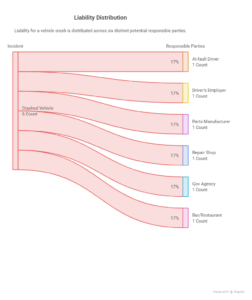
More than one party can be liable for a Seattle T-bone accident. The careless driver is the most common defendant. But an employer, a vehicle maker, a repair shop, a bar, or a government agency may also share fault.
Many people think only the driver who hit them can pay. That is not always true. A skilled side-impact collision attorney looks at every party that helped cause the broadside crash. More defendants can mean more insurance money for your medical bills, lost wages, and pain and suffering.
The other driver
Most T-bone car accidents start with driver negligence: running a red light, a right-of-way violation, or failure to yield.
The driver’s employer
If the at-fault driver was working, their employer may share fault. This covers delivery vans, work trucks, and rideshare drivers. We handle these claims and related Uber accident and Lyft accident cases too.
A vehicle or parts maker
Sometimes a vehicle defect causes the crash. Failed brakes, a stuck throttle, or a faulty airbag can turn a near miss into a side-impact collision. The carmaker or parts maker may be liable.
A repair or maintenance shop
A shop that did bad brake work or skipped a needed repair can be on the hook when that failure leads to a broadside crash.
A government agency
A broken traffic signal, a missing stop sign, or a poorly built intersection can cause a T-bone accident. The Seattle Department of Transportation, the Washington State Department of Transportation, or King County may be liable. These claims follow special rules. You file a written tort-claim notice first, then wait about 60 days before you can sue (RCW 4.96.020). Deadlines are short, so act fast.
A bar or restaurant
In a drunk driving T-bone crash, a bar that kept serving an obviously drunk driver may share fault under Washington’s overservice rules (RCW 66.44.200).
Common Causes of T-Bone Collisions in Seattle
Running a red light, failure to yield, distracted driving, and speeding cause most T-bone accidents. Seattle’s heavy traffic and complex intersections raise the risk, especially during rush hour.
Most broadside car crashes come from a negligent driver. Common causes include:
- Running red lights, the top cause of intersection crashes
- Failure to yield, often during left turns (left-turn accidents)
- Distracted driving, such as texting or phone use
- Speeding that prevents a safe stop
- Drunk driving and aggressive driving
- Improper turns from the wrong lane
- Poor weather conditions, like rainy roads, fog, or ice
- Parking lot accidents, where blind spots cause side-impact crashes
High-Risk Seattle Intersections
These spots see frequent T-bone accidents: Denny Way and Aurora Avenue; Pike Street and 1st Avenue; Capitol Hill along Pine Street; Mercer Street and Dexter Avenue; and Rainier Avenue and Martin Luther King Jr. Way. About 60% of serious injury crashes happen at intersections.
Types of Injuries from T-Bone Accidents
T-bone accidents cause traumatic brain injuries, spinal cord damage, broken bones, and internal injuries. These serious injuries often need long-term medical care and large compensation. In severe cases, victims suffer catastrophic injuries that permanently alter their ability to work and live independently.
The sudden, violent impact creates forces your body cannot handle. Medical bills pile up fast.
Common injuries we see
- Head and brain: concussions, skull fractures, and traumatic brain injuries that affect memory
- Spine: herniated discs, spinal cord damage and paralysis, and chronic neck and back pain
- Bones: rib, arm, shoulder, leg, and pelvic fractures
- Other: internal organ damage, chest injury, nerve damage, soft tissue injury, and facial trauma
Long-Term Medical Treatment
Many T-bone accident victims need ongoing care: multiple surgeries, physical therapy, occupational therapy, counseling for emotional trauma, and adaptive equipment. Rehabilitation costs and future medical care can run high. Serious cases can exceed $200,000 in treatment.
What to Do After a T-Bone Accident in Seattle
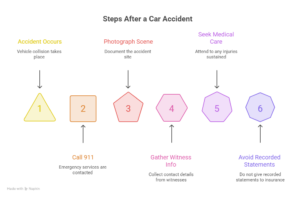
Get medical care, document the scene, collect witness information, and call a skilled car accident lawyer. Do not admit fault or accept a quick settlement offer.
Your steps after the crash protect your health and your case.
At the scene
- Call 911. Get police and paramedics there. Adrenaline can hide serious injuries.
- Document everything. Photograph all vehicles, the intersection, traffic signals, street signs, and your injuries.
- Gather information. Exchange insurance details, get witness names and numbers, and note officer names and badge numbers.
- Get medical care. Visit an emergency room even if you feel fine. Some injuries show up later.
What not to do
- Do not admit fault or apologize
- Do not sign anything except police paperwork
- Do not give a recorded statement to the insurer
- Do not accept a quick settlement offer
How Much Compensation Can You Get for a T-Bone Accident?
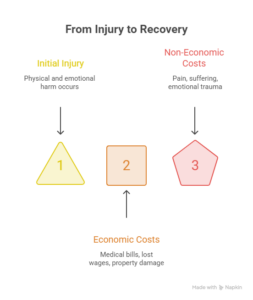
T-bone accident compensation covers medical bills, lost wages, property damage, and pain and suffering. Our car accident lawyers recover settlements through negotiation and trial.
Every case is different. Your compensation depends on injury severity, fault, and your financial losses.
Economic damages
Medical bills from emergency care through recovery, lost wages, future medical care, lost earning power, rehabilitation costs, and property damage to your vehicle.
Non-economic damages
understanding Pain and suffering, emotional trauma, loss of consortium, and quality of life damages.
Is there a limit on pain and suffering?
No. Washington does not cap pain and suffering in a T-bone accident case.
The state Supreme Court struck down the cap in Sofie v. Fibreboard (1989). A jury can award full quality of life damages and emotional trauma based on the facts of your case.
What if the other driver had no insurance?
Your own coverage can still pay. Washington requires only $25,000 in injury coverage per person, $50,000 per crash, and $10,000 for property damage.
Serious side-impact collisions cost far more than that. If the at-fault driver had no insurance or too little, your Uninsured/Underinsured Motorist (UM/UIM) coverage can step in. UM/UIM also helps in hit-and-run T-bone crashes. If you carry Personal Injury Protection (PIP), it can pay early medical bills no matter who caused the crash.
Losing a loved one in a T-bone crash
Families can file a wrongful death claim when a T-bone accident is fatal.
RCW 4.20.010 lets a personal representative bring the claim. RCW 4.20.020 lists who can recover: a spouse or domestic partner, children, then parents or siblings. A survival action (RCW 4.20.046) covers the victim’s own losses before death, such as medical bills and pain.
How Long Do You Have to File a T-Bone Accident Claim in Washington?
You usually have three years to file a T-bone accident lawsuit in Washington. The deadline comes from RCW 4.16.080. Miss it, and the court can throw out your case for good.
This three-year filing deadline is called the statute of limitations. For most injury claims, the clock starts on the day of the crash.
Key deadlines to know
- Injury claims: three years from the crash date (RCW 4.16.080)
- Wrongful death claims: three years from the date of death (RCW 4.20.010)
- Claims against the City of Seattle, King County, or the state: file a written tort-claim notice first, then wait about 60 days before filing suit (RCW 4.96.020)
- Child victims: the clock can pause until the child turns 18
Waiting hurts your case. Traffic camera footage gets erased in days. Witnesses forget. Vehicle black box data can be lost. Early action by a T-bone accident attorney locks down the proof. Evidence disappears. Witnesses forget. Start today.
Why Choose Elsner Law Firm for Your T-Bone Accident Case?
Elsner Law Firm brings 18+ years of experience, Super Lawyers recognition, and a record of successful settlements. We offer free consultations and work on contingency, with no upfront cost.
When you choose our firm, you get personal attention from attorneys who handle T-bone accident cases.
- Justin Elsner, founding attorney, admitted to the Washington Bar in 2007, with Super Lawyers Rising Star recognition
- 50 years of combined personal injury experience, licensed in all Washington State courts
- Members of the Washington Association for Justice and the King County Bar Association
- Limited caseloads, so you work directly with an experienced attorney
- No fee unless we win, with in-person and virtual meetings
What Happens After You Hire a T-Bone Accident Lawyer?
Most T-bone accident cases settle in a few months to a couple of years. The timeline depends on your injuries, the fault dispute, and how the insurance company acts.
Here is what to expect at each step.
- Free case review and investigation. We gather the police report, eyewitness statements, traffic camera evidence, and vehicle black box data.
- Medical treatment. We often wait until you reach maximum medical improvement (MMI), the point your doctor says you have healed as much as you will. It lets us value future medical care, not just today’s medical bills.
- Demand and negotiation. We send the insurance company a demand backed by proof and push for a fair number.
- If the insurer will not pay fairly, we file in King County court.
- Settlement, arbitration, or trial. Most cases settle. We prepare every case as if it will go to trial.
Insurance companies use delay tactics. Slow replies, repeat paperwork, and lowball offers are common. Our T-bone accident lawyers answer those moves and keep your case moving.
Meet Your Seattle T-Bone Accident Attorney
Justin Elsner founded Elsner Law Firm in 2007 after graduating cum laude from Seattle University School of Law with a B.A. from Central Washington University. He is a member of the Washington State Bar Association and admitted to practice in the Western District of the Federal Court. Justin has spent over 17 years fighting for drivers, passengers, and pedestrians hurt in side-impact collisions at Seattle’s intersections and across Washington State going up against negligent drivers, their insurers, and anyone else who tries to shift blame or minimize what victims are owed.
Justin’s path to this work is personal. A life-changing car crash during his high school years left him and his family feeling lost and unsure of how to move forward. Watching firsthand how aggressively insurance companies work to minimize what injured people receive and how different the outcome was once a personal injury attorney stepped in left a mark that never faded. That experience became the foundation for everything he built at Elsner Law Firm: a practice rooted in the belief that someone hurt in a T-bone accident deserves a lawyer who fights just as hard for them as the at-fault driver’s insurance carrier fights against them.
He has authored two client guides: “7 Mistakes Accident Victims in Washington Make And How to Avoid Them” and “Your Guide to the First 30 Days After a Crash” because informed clients consistently reach better outcomes.
His caseload covers drivers and passengers injured in side-impact collisions at Seattle-area intersections, T-bone crashes caused by red-light running, failure to yield, and distracted or impaired driving, disputed liability cases where insurers argue over right of way and traffic signal compliance, accidents involving uninsured or underinsured motorists, intersection crashes on high-risk corridors like Rainier Avenue and Aurora Avenue, catastrophic injuries including traumatic brain injuries, spinal cord damage, and pelvic fractures, and wrongful death claims arising from fatal T-bone collisions throughout Washington State.
Victims of such harm are entitled to seek compensation for medical expenses, lost wages, pain and suffering, and long-term rehabilitation needs. In the most serious cases involving permanent disability, claims may also include loss of earning capacity and loss of consortium for the impact a catastrophic injury has on family relationships.
If you or a loved one was injured in a T-bone accident in Seattle, call or text Elsner Law Firm at 206-447-1425 for a free consultation.
Frequently Asked Questions
Who is usually at fault in a T-bone accident?
The driver who broke the right-of-way rule is usually at fault. That often means a driver who ran a red light or failed to yield. Fault depends on who had the right of way, not on who hit whom.
Can I still get paid if I was partly at fault?
Yes. Washington uses pure comparative negligence (RCW 4.22.005). Your award drops by your share of fault, but you can still recover, even if you were mostly to blame.
How much is my T-bone accident case worth?
It depends on your injuries, your bills, and the fault evidence. Traumatic brain injuries, spinal damage, and paralysis tend to bring higher settlements. Strong proof of the other driver’s fault raises value too.
Is there a cap on pain and suffering in Washington?
No. Washington has no cap on pain and suffering. A jury can award full quality of life damages and emotional trauma after the state cap was struck down in 1989.
What if the other driver had no insurance or drove off?
Your UM/UIM coverage can pay. It covers uninsured, underinsured, and hit-and-run T-bone crashes. Personal Injury Protection (PIP) can pay early medical bills too.
How long do I have to file a claim?
Three years for most injury claims (RCW 4.16.080). Claims against a city, county, or the state have extra steps and shorter notice rules, so call early.
How much does a T-bone accident lawyer cost?
Nothing up front. We work on a contingency fee. You pay no fee unless we win money for you. The first case review is free.
What should I do right after a side-impact crash?
Call 911, get medical care, and save evidence. Take photos, collect witness names, and avoid giving a recorded statement to the insurer. Then call a Seattle T-bone accident lawyer.
Talk to a Seattle T-Bone Accident Lawyer Today
Talk to a Seattle T-bone accident lawyer before you talk to the insurance company. You are hurt, the bills are stacking up, and the insurer wants a quick, cheap deal. Our team can take that weight off your plate. We serve injury victims in Seattle, Bellevue, Kirkland, Tukwila, Southcenter, and across King County and the Puget Sound region. Get in touch today. Call (206) 447-1425 for a free case review. You pay nothing unless we win.